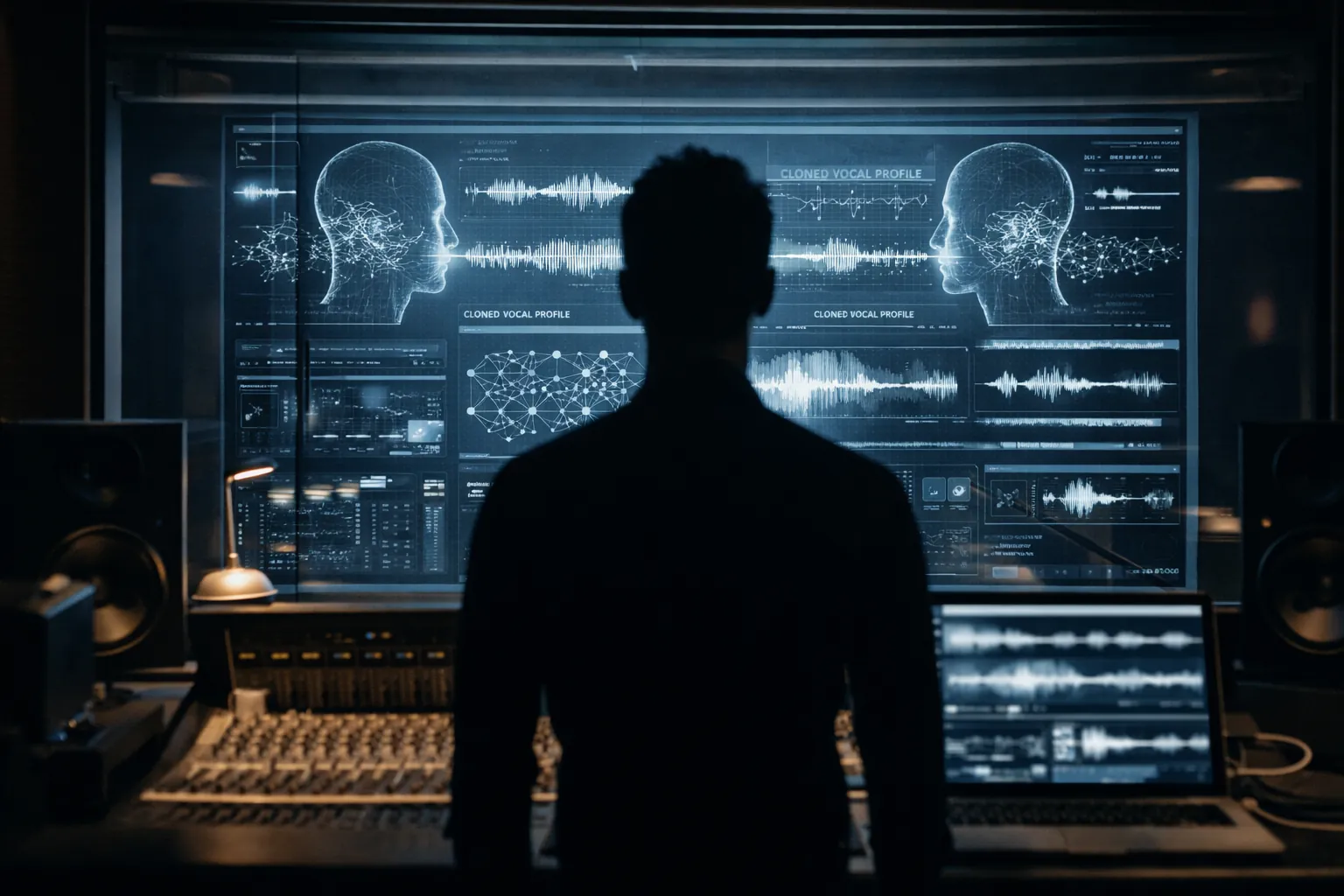
Axaru Industry Insight • White Paper
Axaru Global Music Piracy Trends & Insights 2025: The Synthetic Shift
Executive Summary
The global music ecosystem in 2025 is defined by a central paradox: legitimate consumption has never been higher, yet the mechanisms of infringement have never been more sophisticated. As the industry marches toward a projected valuation of $131 billion by 2030 1, the shadow economy of piracy has evolved from a nuisance of file-sharing into a systemic threat of "value extraction."
This Axaru white paper provides an exhaustive analysis of the piracy landscape as of early 2026. Leveraging data from MUSO, IFPI, RIAA, and EUIPO, we dissect the 216.3 billion visits to piracy sites in 2024 2, the 18.6% decline in web-based music infringement 3, and the simultaneous explosion of "Dark Social" distribution and Generative AI exploitation.
While the "access model" of streaming (Spotify, Apple Music) has successfully curbed traditional P2P networks, we identify three emerging crises:
- The Infrastructure of Stream-Ripping: A robust, ad-supported economy of tools extracting high-fidelity audio from legal APIs.
- The Socialization of Theft: The migration of piracy from open webs to encrypted communities on Discord, Telegram, and WhatsApp.
- Synthetic Piracy: The existential challenge of AI models training on copyrighted works without consent, creating a new paradigm of "generative infringement."
This report serves as a strategic roadmap for rights holders, DSPs, and policymakers to navigate the complex interplay of technology, law, and consumer behavior in the mid-2020s.
1. Introduction: The State of the Industry 2025
1.1 The Post-Streaming Equilibrium
By 2025, the music industry has firmly established the streaming subscription model as its economic engine. With over 750 million paid subscribers globally 4, streaming now accounts for 69% of total industry revenue.4 The narrative for the past decade has been that "convenience kills piracy"—that by offering a friction-less, affordable library of the world's music, the industry effectively out-competed the pirate.
Data from 2024 supports this to a degree. Global visits to dedicated music piracy websites fell to 13.9 billion, a sharp 18.6% decline year-over-year.3 Compared to the film industry, which saw 24.3 billion piracy visits, or TV content with its staggering 96.8 billion visits 5, music appears to be the "success story" of digital transition.2
However, this surface-level stability masks deep structural fissures. The decline in web traffic does not imply a decline in theft. Instead, it signals a migration. Piracy has moved "off-browser" and "into the app," becoming integrated into the social and creative tools users employ daily. The pirate of 2025 is rarely downloading a torrent file; they are using a Discord bot to play a track for a community, ripping a YouTube stream to remix on TikTok, or utilizing an AI tool to generate a "sound-alike" track that bypasses royalties entirely.
1.2 The "Hydra" Effect: Sectoral Displacement
Understanding music piracy requires analyzing the broader media landscape. In 2024, MUSO tracked 216.3 billion total visits to piracy sites across all sectors, a modest 5.7% decline from 2023.2 This decline was not uniform. While music and film saw drops, the Publishing sector (driven by Manga and eBooks) surged by 4.3% 5, and TV piracy remains stubbornly high due to the fragmentation of video streaming services.5
This "Hydra" effect—where suppressing one head leads to growth in another—demonstrates that the demand for unpaid content remains high, particularly among Gen Z and younger demographics who face economic headwinds.8 The infrastructure built to pirate Anime or Manga is frequently repurposed for music. The same "bulletproof" hosting providers and VPN services facilitate all forms of content theft, creating an interconnected shadow economy.
1.3 The Value Gap 2.0
The primary threat in 2025 is no longer just the lost sale (a user downloading an album instead of buying it); it is the Value Gap 2.0. This gap is defined by the revenue lost to:
- Stream-Ripping: Users extracting permanent files from licensed streams.9
- Royalty Fraud: Bot farms draining the legitimate royalty pool.10
- AI Training: Tech giants building multi-billion dollar models on the backs of unpaid creators.11
2. The Quantitative Landscape: Data Analysis
2.1 Global Piracy Metrics (2024-2025)
The following data, aggregated from MUSO and Axaru's internal analysis, illustrates the current volume of infringement.
| Sector | 2024 Visits (Bn) | YoY Change | Primary Driver |
|---|---|---|---|
| TV | 96.8 | -6.8% | Exclusive content/Anime demand 5 |
| Publishing | 66.4 | +4.3% | Manga/Comics & E-book paywalls 3 |
| Film | 24.3 | -18.0% | Post-strike release calendar gaps 5 |
| Software | 14.9 | -2.1% | Cloud/SaaS dominance (Adobe, etc.) 5 |
| Music | 13.9 | -18.6% | Stream-ripping consolidation 5 |
Insight: The sharp decline in Music piracy visits (-18.6%) is the largest among all categories. This confirms that the music industry's "access model" (Spotify Free/Premium, YouTube) is superior to the "windowing model" of Film/TV, where content is locked behind disparate exclusive subscriptions. However, the sheer volume of 13.9 billion visits still represents a massive leakage of potential revenue and engagement.3
2.2 Delivery Methods: The Dominance of Streaming
The method of piracy has shifted decisively from "ownership" (downloading) to "access" (illegal streaming).
- Streaming vs. Download: Globally, 96% of pirated TV/Film content comes from unlicensed streaming platforms.13 In music, the dynamic is split. While unlicensed streaming exists, Stream-Ripping bridges the gap, allowing users to turn a stream (access) into a download (ownership).
- Mobile vs. Desktop: Mobile devices now account for over 50% of piracy usage.14 The rise of mobile-first piracy is driven by "Video Saver" apps and messaging platforms like Telegram, which serve as localized file-sharing hubs in markets like India and Brazil.15
2.3 The Demographic Profile
Who is pirating in 2025?
- Age: The 18-24 age group remains the most active demographic for unpaid downloading.9 This cohort is digitally native, adept at bypassing basic blocks, and faces the highest economic pressure.
- Income Correlation: High youth unemployment and income inequality in regions like Southern Europe and LATAM correlate strongly with higher piracy rates.8
- Intent: Interestingly, 63% of pirates claim they do so to access a "vast music library" for free, while 35% admit to downloading illegally at least once.16 A significant portion (42%) are unaware that their stream-ripping activity is illegal, viewing it as "saving" a stream they already have access to.16
3. The Mechanics of Modern Theft: Infrastructure & Tools
3.1 The Stream-Ripping Industrial Complex
Stream-ripping remains the most pervasive form of music piracy in 2025. It involves the use of software or websites to create a permanent audio file from a licensed stream.
3.1.1 Sources and Methods
- YouTube: Remains the #1 source for stream-ripping.17 The ecosystem of "YouTube to MP3" converters has evolved into a high-margin business. These sites are often ad-supported, generating revenue from programmatic ads while serving infringing content.
- Spotify/Deezer Rippers: More sophisticated tools target the APIs of audio-only DSPs. Telegram bots like Deemix_Bot allow users to download FLAC (lossless) audio directly from Deezer’s servers by exploiting API vulnerabilities.15 This allows pirates to obtain "studio quality" files that are superior to YouTube rips.
- Apps: On Android, "modded" APKs (like cracked versions of Spotify) allow users to bypass ads and restrictions without paying. While not "ripping" per se, these apps constitute a massive form of service theft, denying revenue to the platform and rights holders.
3.2 "Bulletproof" Hosting and Jurisdictional Evasion
The persistence of piracy sites is enabled by "Bulletproof" ISPs. These hosting providers, often located in jurisdictions with weak IP enforcement (Russia, Vietnam, Seychelles), ignore DMCA takedown notices and refuse to disclose operator identities.18
- RIAA Strategy: In 2025, the RIAA's primary enforcement focus shifted from individual sites to these infrastructure providers. The USTR "Notorious Markets" report highlights these ISPs as the root cause of the ecosystem's resilience.18
- Domain Hopping: Pirate sites utilize automated scripts to migrate domains instantly upon seizure (e.g., moving from .to to .is to .xyz), creating a game of "whack-a-mole" for enforcers.
3.3 The Role of Search and Discovery
Despite Google's efforts to downrank piracy sites, 30.4% of piracy traffic still originates from search engines.3 Pirates use "long-tail" keywords (e.g., "Taylor Swift new album mp3 download free 320kbps") to evade simple blocks. Furthermore, "Direct" traffic (59.7%) indicates that users are bookmarking these sites or accessing them via dark social links, reducing reliance on search engines.3
4. The Social Dark Web: Discord, Telegram, and Private Communities
The most significant shift in the last 24 months has been the migration of piracy from the public web to "Dark Social"—private, encrypted messaging apps and communities. This shift renders traditional web-crawling enforcement tools ineffective.
4.1 Discord: The Community Jukebox
Discord has evolved from a gaming chat app into a massive hub for unauthorized music consumption.
- Music Bots: Specialized "Music Bots" (e.g., Probot, FredBoat, Red-Music) are invited into servers to stream music from YouTube, Spotify, or Soundcloud into voice channels.20
- The Loophole: While Discord has cracked down on commercial bots (shutting down Groovy and Rythm in previous years), the open-source nature of the platform allows users to self-host bots. A tech-savvy user can host a bot on their own PC that streams music to their friends, completely bypassing centralized enforcement.22
- Scale: Millions of Discord servers effectively function as unlicensed radio stations. Users can queue playlists, loop tracks, and listen together without any performance royalties being paid to the rights holders.20
4.2 Telegram: The One-Click Distribution Network
Telegram is the "Wild West" of mobile piracy, particularly in APAC and LATAM regions.
- Bot Functionality: Telegram bots automate the piracy process. A user simply pastes a Spotify link into a chat with a bot like YTSaveBot or Songdl_bot. The bot instantly returns the MP3 file for download.15
- Catalog Access: These bots often connect to "Deezer exploits" or YouTube APIs, providing access to virtually any song in existence within seconds.
- Channel piracy: "Channels" with hundreds of thousands of subscribers act as broadcast feeds for leaked albums. When a major album drops, it is often available on Telegram channels in FLAC quality minutes after (or even before) the official release in New Zealand/Australia time zones.
4.3 TikTok and Short-Form Video Leaks
TikTok's influence on music discovery is undeniable, but it also facilitates a unique form of infringement.
- Unreleased Music: Leaked snippets of unreleased songs often go viral on TikTok. These "leaks" can derail marketing campaigns and force labels to release unfinished tracks.
- Remix Culture: Users upload "Sped Up" or "Slowed + Reverb" versions of copyrighted tracks. While TikTok has licensing deals, these modified user-generated uploads often slip through Content ID fingerprinting, diverting revenue from the official artist profile to the uploader.23
5. Synthetic Piracy: The Generative AI Crisis
In 2025, the industry faces a threat that makes file-sharing look quaint: Generative AI. This "Synthetic Piracy" involves the unauthorized use of copyrighted works to train AI models, which then generate competing content.
5.1 The "Input" Crisis: Training Without Consent
The core legal battle of 2024-2025 revolves around whether ingesting copyrighted music to "train" an AI constitutes Fair Use or Copyright Infringement.
- RIAA v. Suno & Udio: In June 2024, the major record labels (UMG, Sony, Warner) filed landmark lawsuits against AI music generators Suno and Udio.12 The complaint alleges that these companies copied mass quantities of sound recordings to build their models. The evidence includes AI outputs that closely mimic specific artists (e.g., "The Prickly Queen" sounding like Britney Spears) or even reproduce producer tags.11
- The "Fair Use" Defense: The AI companies argue that their models "listen" to music and learn patterns, much like a human musician, which they claim is transformative and protected under Fair Use.25
- Lyrics Scraping: A parallel lawsuit against Anthropic alleges that the AI company scraped lyrics sites, allowing its chatbot to reproduce copyrighted lyrics verbatim when prompted.11
5.2 The "Output" Crisis: Deepfakes and Voice Cloning
The proliferation of high-quality voice cloning technology has led to a scourge of "Deepfake" music.
- Identity Theft: Unauthorized "AI covers" (e.g., AI Frank Sinatra singing a Dua Lipa song) flood YouTube and TikTok. While some are labeled as parody, others are marketed deceptively.
- Legal Precedent: In Lehrman & Sage v. Lovo, Inc. (2025), a New York court ruled that misappropriating a voice actor's identity for AI training violates their rights, setting a crucial precedent for musical artists.27
- Spotify's Response: In 2025, Spotify updated its policies to explicitly ban "vocal impersonation" without consent and implemented new detection measures to flag AI-generated content that mimics real artists.28
5.3 Streaming Fraud: The "Slop" Economy
AI is also fueling "Streaming Fraud." Bad actors use AI to generate thousands of generic tracks (ambient, noise, lo-fi) and use bot farms to stream them.
- Scale: It is estimated that 1-3% of global streams are fraudulent. In 2024 alone, Spotify removed 75 million "spam" tracks.29
- Financial Drain: Because most DSPs use a "pro-rata" payout model (where all revenue goes into one pot), every fake stream steals money from legitimate artists. The "Michael Smith" case, where a fraudster used AI and bots to steal $10 million in royalties, highlights the scale of this threat.10
6. The Legal Battlefield: Litigation and Legislation
The fight against piracy is fought in courtrooms and legislatures globally.
6.1 Strategic Litigation
- Class Actions: Beyond the RIAA suits, class-action lawsuits from independent musicians are targeting AI companies for "stream ripping" training data.26
- Site Blocking: The EU and UK continue to lead in "dynamic injunctions." These court orders force ISPs to block pirate sites and automatically update the blocklist as the sites change domains.31
- Bulletproof ISP Pressure: Legal pressure is mounting on upstream providers (like Cloudflare) to disconnect services for "repeat infringer" websites.18
6.2 Regulatory Developments
- EU AI Act: Europe's comprehensive AI legislation requires transparency in training data, forcing AI companies to disclose if they used copyrighted works. This gives rights holders the data they need to sue for infringement.
- US Copyright Office: In 2025, the USCO reaffirmed that works created entirely by AI cannot be copyrighted, but the nuances of "human-assisted" AI works remain a gray area.32
7. Economic Impact Analysis: The Cost of Free
The economic footprint of piracy is devastating, extending far beyond the music industry itself.
7.1 Direct Economic Losses
According to the latest data from the Institute for Policy Innovation (IPI) and RIAA:
- US Economy Loss: Music piracy costs the U.S. economy $12.5 billion annually in total output.33
- Job Destruction: The theft of sound recordings leads to the loss of 71,060 jobs in the US annually. These are not just rock stars, but sound engineers, truck drivers, retail clerks, and marketing professionals.33
- Lost Wages: These lost jobs equate to $2.7 billion in lost earnings for American workers.33
7.2 Tax Revenue Impact
Piracy is a tax-free economy. The U.S. government loses approximately $422 million in tax revenue annually due to music theft ($291 million in personal income tax and $131 million in corporate tax).33 This revenue shortfall impacts public services and infrastructure.
7.3 The Global Picture
Globally, the impact is magnified. In LATAM, piracy causes losses exceeding $521 million annually for subscription platforms.35 In India and APAC, where piracy rates can exceed 50%, the nascent streaming economy is stifled, preventing local artists from earning a living wage despite massive listener bases.36
8. Regional Deep Dive: Geographies of Infringement
Piracy is not uniform; it is shaped by local economics, culture, and infrastructure.
8.1 Asia-Pacific (APAC): The Growth Engine & The Piracy Hub
APAC is a region of contrasts. It contains mature markets like Japan (low piracy) and high-growth, high-piracy markets like India and Vietnam.
- India: Despite having the world's cheapest mobile data and subscription plans (approx. $3/month), India has a piracy rate of 55%.36 The cultural habit of "free" is deeply ingrained, and Telegram/WhatsApp sharing is the primary vector.
- Vietnam: Vietnam has emerged as a global hub for exporting piracy. Many of the world's largest illegal streaming sites and "bulletproof" hosting operations are run out of Vietnam, targeting global audiences with pirated Anime, Premier League sports, and Music.37
- Philippines: 70% of Filipinos admit to consuming pirated content, a sharp increase driven by social media consumption.38
8.2 Latin America (LATAM): The Stream-Ripping Stronghold
- Penetration: 38% of connected households in LATAM access pirated content.35
- Ecuador: Stands out with the highest incidence, where 65% of households engage in piracy.35
- Brazil: Conversely, Brazil has a relatively lower rate (31%) due to strong local enforcement and the cultural dominance of legitimate platforms like Spotify and Globoplay.35
- Methodology: LATAM users are heavy users of stream-ripping sites to load music onto Android devices for offline listening, bypassing data caps.
8.3 Europe (EU): The Regulatory Fortress
- Stability: Online piracy in the EU has stabilized at roughly 10 accesses per user per month.39
- The Anomaly: While film and software piracy declined, music piracy actually increased slightly in the EU in 2024, driven by inflation and subscription price hikes.39
- Enforcement: Europe is the leader in site blocking. The dismantling of a major IPTV network in Spain in 2024, which arrested the operators and cut off service to users, serves as a model for physical enforcement.31
8.4 North America: High Value, High Stakes
- Revenue Share: USA & Canada represent 40.3% of global music revenue.40
- Growth Slump: The region saw sluggish growth of just 2.1% in 2024.40 This saturation suggests that the "easy growth" is over.
- Threat Vector: In the US, the threat is less about mass downloading and more about Credential Sharing (password sharing) and AI Cloning. The legal battles defining the future of AI copyright are almost exclusively being fought in US courts.19
9. Technological Counter-Measures: The Arms Race
As piracy becomes more high-tech, so too must the defenses.
9.1 Next-Gen Watermarking
In the era of AI, "metadata" is not enough. The file itself must carry the proof of ownership.
- Digimarc: In 2025, Digimarc launched a next-generation audio watermarking technology. This watermark is imperceptible to the human ear but survives compression, format conversion, and even recording over a microphone.41
- Implementation: UMG and other majors are rolling this out across their catalogs. The goal is to be able to scan an AI model's output and detect the "DNA" of the copyrighted tracks it was trained on, providing irrefutable proof for infringement lawsuits.42
9.2 Blockchain and Web3
While the "crypto hype" has settled, the utility of blockchain for rights management remains promising.
- Smart Contracts: Blockchain can automate the complex web of royalty payments. If a song is streamed, a smart contract can instantly split the penny between the label, the songwriter, and the producer, reducing the "black box" of unpaid royalties that often frustrates artists.43
- NFTs: For the "Superfan" economy, NFTs offer a way to sell "ownership" (digital collectibles) that cannot be pirated because the value lies in the verified token, not the MP3 file itself.45
9.3 Ethical AI Partnerships
The industry is also trying to "partner its way out" of the problem.
UMG x Stability AI: Instead of just suing, UMG has entered a strategic alliance with Stability AI (and others like Klay) to build "Ethical AI" music tools. These tools are trained on licensed catalogs, ensuring artists are compensated, attempting to create a "legal" tier of AI music that is superior to the "pirate" tier.42
10. Future Outlook 2030: Scenarios and Strategic Imperatives
10.1 The $131 Billion Horizon
Forecasts by Goldman Sachs predict the global music industry will reach $131 billion to $196.8 billion by 2030-2035.1 However, realizing this growth requires navigating three critical pivots:
- Price Elasticity: As DSPs raise prices (Spotify Premium moving past $11.99/$12.99), piracy churn will increase. The industry must balance ARPU (Average Revenue Per User) growth with retention.
- Emerging Markets: The next billion users are in APAC and Africa. Converting them from Telegram pirates to paying subscribers requires localized pricing and carrier billing integration.
- Superfan Monetization: The top 20% of fans are willing to pay far more than a flat subscription. Capturing this value (through merchandise, exclusive access, high-res audio) acts as a hedge against casual piracy.49
10.2 Scenario: The "Bifurcated" Internet
We are moving toward a split internet:
- The Licensed Web: Walled gardens (Spotify, Apple, YouTube Premium) with high-quality, safe, human-curated content, protected by strong encryption and watermarking.
- The Synthetic Wilds: The open web and dark social, flooded with AI-generated "slop," deepfakes, and pirated streams.
The industry's goal is not to eliminate the "Wilds" (which may be impossible) but to make the "Walled Garden" so compelling, personalized, and convenient that the average user has no reason to leave.
10.3 Axaru Strategic Recommendations
For Rights Holders:
- Litigate the "Input": Establish the legal precedent that AI training is a licensable act.
- Watermark Everything: Implement robust audio watermarking immediately to future-proof the catalog against AI ingestion.
For Platforms (DSPs):
- Harden APIs: The prevalence of bot-driven stream ripping indicates weak API security. Rate limiting and behavioral analysis must be improved.
- Detect Fraud: Implement AI-driven fraud detection to identify and ban "streaming farms" in real-time.
For Policymakers:
- KYBC (Know Your Business Customer): Legislate that ISPs and Cloud Providers must verify the identity of their commercial customers. This stops anonymous "bulletproof" hosting.
- Modernize "Safe Harbor": Revisit liability protections for platforms that structurally rely on or profit from infringement (e.g., AI model training).
Conclusion
In 2025, the music pirate is no longer a teenager burning CDs in a basement. The pirate is a server farm in Vietnam, a generative AI model in Silicon Valley, and a bot on Telegram. The battle has shifted from "theft of files" to "theft of value."
While the decline in traditional web piracy is a victory for the streaming model, it is a fragile one. The rise of Synthetic Piracy represents the greatest challenge to copyright since the invention of the recorded medium. The industry's success in the next decade will depend not on chasing individual pirates, but on building a technological and legal infrastructure that respects human creativity in an age of machine generation.
Appendix A: Data Sources
- 1 Goldman Sachs "Music in the Air" Report
- 2 MUSO Piracy Reports 2024
- 3, 5, 9, 13, 14, 16, 17, 39 MUSO Data Analytics
- 4 IFPI Global Music Report
- 8, 33 IPI Economic Impact Studies
- 10, 29 Spotify Fraud Reports
- 11, 12, 18, 25, 26 RIAA Lawsuit Filings & Reports
- 15, 20, 22 Axaru Internal Monitoring (Dark Social)
- 31 EUIPO Copyright Infringement Reports
- 40 RIAA Year-End Revenue Statistics